
 0
0 0
0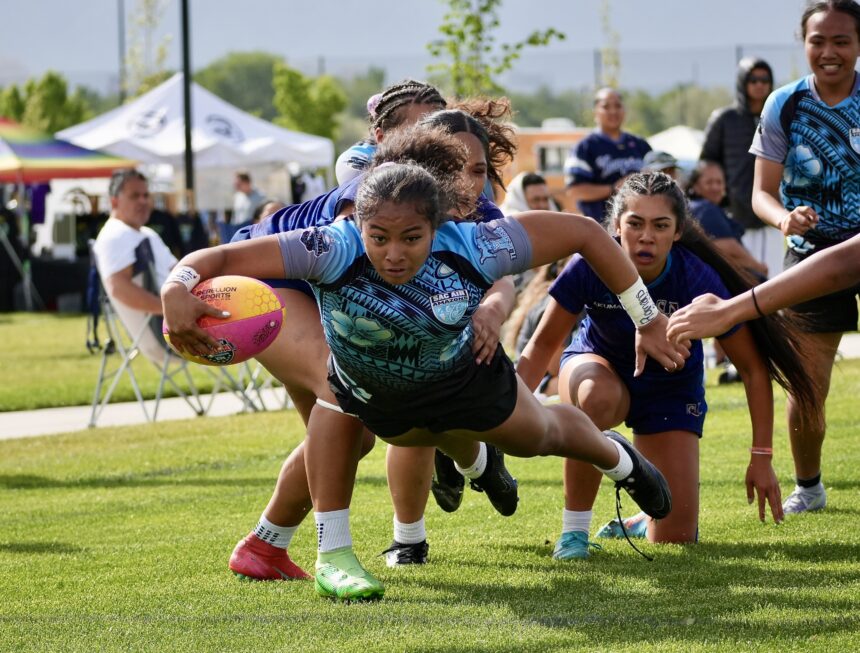
It’s been a few weeks since the Girls’ High School and High School Club 15s national tournaments wrapped in Salt Lake City, and there has been plenty to digest from the event. There was newness in the location, host, teams and competition formats. There was also familiarity in the awe that builds while watching the country’s top teenage talent come together and challenge each other. The Girls High School National XVs Committee is applying all of its learnings to the 2027 event, which will return to the Regional Athletic Complex in Utah. [lead photo: Putting the “air” in SacAIR Amazons / Jackie Finlan]

https://nextphaserugby.com
First, the rugby. It is the one piece of the nationals equation that never disappoints. Spectators peer into the future watching teams like club (and middle school) champion Belmont Shore and single-school champion Eagle High School play, and boy, did the opposition push back for some spectacular rugby. Both the club and single-school divisions offer Tier 2 options, and it’s so fun to see which teams want that nationals experience while building a program that could be Tier 1 one day.
The scouts and recruiters are also a constant. NCAA Division I Sacred Heart University Women’s Rugby Head Coach Michelle Reed, while considering which high school events provide the best recruitment opportunities, asserted, “You have to be here.”
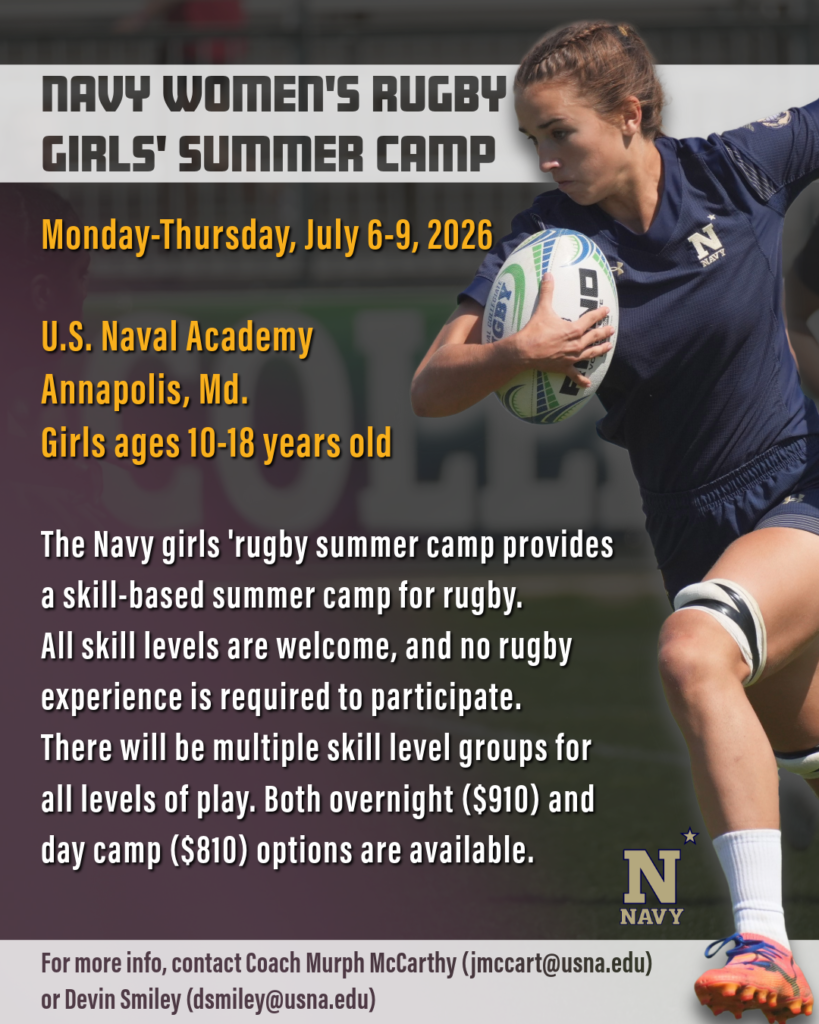
https://navysports.evenue.net/events/GR-CAMP
She had assistant coach Salvatore Tondi in tow, while American International College (Jay Bonti, Annekkia Ritter-Truxal) and Lindenwood (Trevor Locke, Colton Hernandez) also had two coaches scouring the grounds. Harvard led with three reps in Mel Denham, Catie Benson and Matai Leuta. Army (Carolyn Roach), New Haven (Emily Record), Dartmouth (Lisa Jackson) were all present, among many other college rugby programs. USA Rugby was well represented, as Girls U18 15s Head Coach Sue Whitwell scouted players for the USA Pathway, and community media lead Calder Cahill filmed the action for the governing body’s social media platforms.
Second, the RAC is just beautiful. The Wasatch Range provides the background, and the grounds themselves funnel everyone into a central meeting space that was packed with food options, vendors and plenty of grass for teams to unfurl and mingle. Massive kudos to Nikki Bartell, who only had a couple of months to promote and build the event locally. She’s on board for the 2027 tournament, and one can only imagine what she’ll do with a year-long runway.

USA Rugby U18 15s Head Coach Sue Whitwell
To boot, the RAC, the Salt Lake City airport and the Utah Youth Rugby (UYR) partner hotels are all within 10-15 minutes of each other. For those taking in the championships from afar, GOLS provided a free live-stream of all fields, a service that is accessed after creating a free account on the website.
A tour to Utah is worth it, and it was enough of a lure for teams like City Honors out of New York and Divine Savior Holy Angels (DSHA) out of Wisconsin to make the trek. They represented the lone representatives from the East Coast and Midwest, respectively. Tennessee champion Father Ryan High School was also signed up and paid as well, until senior graduation requirements forced a withdrawal. The Irish would have been the South rep.
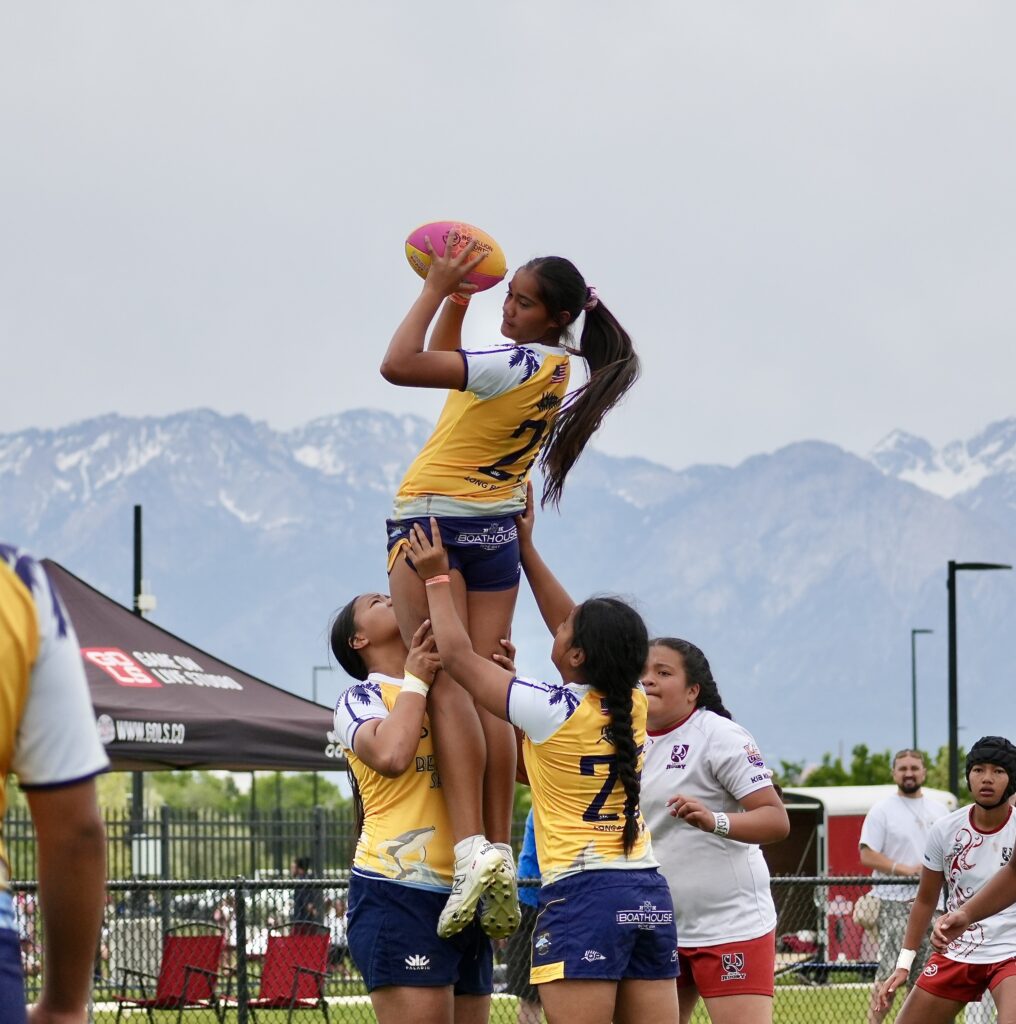
Wasatch Range as backdrop
There was also a massive cohort of women referees headlining the event. That effort was spearheaded by UYR president Alex Nunnally, who is also a referee, and Amanda Cox, the referee manager for Women’s Elite Rugby, the country’s professional 15s competition. UYR and the nationals committee also sponsored The Rugby Breakdown’s attendance (flights, hotel), signifying their appreciation of the girls and women’s game in the U.S.
All of the pieces for a successful event were present in Salt Lake City, but they shouldn’t be taken for granted. Nationals happen because volunteers with full-time jobs and other rugby roles do the work. And talk to any coach, regardless of their experience in Salt Lake City, and they acknowledge and appreciate that contribution. But the Girls High School Nationals Committee does have its work-ons for 2027, and they center around eligibility, communication and forming a stance on what “nationals” means.
The primary controversy centered on the single-school bracket. As the name suggests, it’s meant to feature teams that draw players from one high school, although squads have an allotment for non-students whose own schools do not offer rugby. During the week of nationals, Kahuku High School from Hawaii alerted the committee that it could not travel with its seniors due to graduation requirements and thus picked up players to field a full roster. That circumstance should have pushed the Raiders into the club bracket, but however the committee came to the conclusion of keeping Kahuku in single-school and designating the Raiders’ games as forfeit wins for the opposition – that decision was not communicated to the rest of the field.
Ultimately the result on the pitch saw Meridian take the place of Rocky Mountain in the single-school championship against Eagle High School. Getting to that point, however, was messy and charged, and one felt the impact on Meridian and Rocky Mountain on finals day. Committee chairman Chris Kovac, who is a Rocky Mountain coach, owned the fallout.
“As a committee, we fell short in our communication regarding the Kahuku situation and how it impacted the division,” Kovac explained. “All participating teams deserved timely and transparent information, and that did not happen.
“Given the circumstances, the committee felt it was important to avoid even the appearance of bias,” he continued. “Because I serve as both Chairman and Rocky Mountain’s Head Coach, the committee determined that the best way to protect the integrity and credibility of the tournament was to give Meridian Rocky’s place in the championship match.
“This decision was not based on head-to-head results,” Kovac closed. “Rocky defeated Meridian in pool play and had also beaten them twice during the regular season. Rather, it was a decision made solely to preserve confidence in the fairness and impartiality of the tournament process.”
There were other instances of eligibility issues. For example, the Tier 2 single-school competition also featured combination teams from Utah. Westlake Drua withdrew from the club Tier 2 championship, and fortunately replacement finalist Sacramento Harlequins was able to shuffle for an earlier kickoff. Some of this leniency supported a full bracket and the desire to make the event as big as possible. And that’s where there’s tension. Is nationals a festival of girls’ rugby, or does it potentially trade size in pursuit of legitimacy? Obviously it can be both.
The lack of communication produced ripple effects for the entire field. On the other side of the single-school bracket, DSHA, Eagle and Summit High School were all placed in a pool together. Those three pool games ended up being the most competitive of the tournament, and the committee’s final rankings (*see note at end of article) reflect as much. The Dashers were up against it. The team lost a championship-level game 13-10 against Eagle, and then turned around an hour later to face a fresh Summit.
“They were frustrated for sure,” DSHA head coach Joe Kloiber said of the players. “Getting the girls to calm down, then jump back up and turn it back on for our second game was definitely a challenge. But they rose to the occasion, and it was great to see them respond [against Summit] in that way.”
When DSHA learned about Kahuku and that Rocky Mountain was replacing Meridian in the 3rd place game, the rumor mill filled in the unanswered questions. Ultimately the Dashers didn’t care who they played – it was the seniors’ final run-out and they just wanted to enjoy their time together in Utah – but there is an impact for the future.
“I feel like we should be trying to get rugby into all the schools,” Kloiber said of a major driver behind the existence of a single-school division. “But that’s not going to happen if [the nationals showcase] is more like club all-stars. It’s sad.”
The committee is back to work. It’s already drafted hosting standards and committee responsibilities for 2027. It is adding TRB to the committee for that communication piece, but also for that historical perspective that comes with 20+ years of rugby reportage. It’s surveying teams for more feedback. They’re working not only toward a great event but also for the teams on which a viable national tournament hinges.
A second year at the same location is always a good bet. Utah Youth Rugby and the Girls High School National XVs Committee will evolve in their partnership, and ideally meld goals of a blowout event and legitimate national championship. Stay tuned!
*For background on how the committee compiled rankings, read the initial pitch and round one rankings.
FINAL HS + HS CLUB RANKINGS
1 Belmont Shore (CA)
2 Majestics (UT)
3 United (UT)
4 Eagle (ID)
5 Divine Savior Holy Angels (WI)
6 SacAir Amazons (CA)
7 Summit (CO)
8 Rocky Mountain (ID)
9 San Mateo Wolverines (CA)
10 Sacramento Harlequins (CA)
11 Doylestown (PA)
12 Meridian (ID)
13 Westside Lions (UT)
14 Provo Steelers (UT)
15 Herriman/Kearns (UT)
16 Wasatch (UT)
17 Orchard Park (NY)
18 City Honors (NY)
19 Raleigh Cobras (NC)
20 Salt Lake Venom (UT)
21 Kahuku (HI)
22 Yellowstone Mavericks (MT)
23 West Lake Drua (UT)
24 Downingtown (PA)
25 Lumberjackies (CO)
Honorable Mention
Catholic Memorial (WI)
Corning (NY)
Aspetuck (CT)
Highland (OH)
North Bay Outcasts (MD)
Warsaw (IN)
Kent (WA)
Father Ryan (TN)
Helena Hydra (MT)
Brunswick (OH)
All Comments
Jackie, you came out and watched Doylestown dismantle an all-star team compiled of the best of the (rest of the) east. We had our finishers starting to be subbed in by the middle of the 2nd of 3 halves. I truly hope you address this in your upcoming write-up of the event
The other issue not mentioned is scheduling. Boys Nationals is a week later and allows teams to compete in State Championships before going to Nationals. Doylestown completely dismantled all the top teams on the East Coast. To suggest they aren’t in the Top 10 is just disingenuous (simply counting their D1 NIRA recruits could prove that was false). On the contrary, if they are being penalized for playing their state championship instead of going to nationals, that’s unfair. Reschedule Nationals to align with the Boy’s and you’ll have real nationwide representation.